VISUALIZING
the GIFTS of
Festival Beach Food Forest
A project for collecting and visualizing stories of gifts (physical and intangible) received at Festival Beach Food Forest, a permaculture food forest on a public park in Austin, Texas.
About the project
Contributors
Cathryn Ploehn (point of contact), Angelina Alanis, Jenna Jasso, Aly Tharp, Jodi Lane, Shreyas Sudhaman and the Festival Beach Food Forest community.
This project is generously supported by:
- City of Austin Urban Forest Grant
- Planet Texas 2050
- College of Fine Arts Creative Research Grant
- School of Design and Creative Technologies Summer Research Grant



Email cathryn.ploehn[at]utexas.edu for inquiries.
© 2023 - 2025
The GIFTS of a
FOOD FOREST
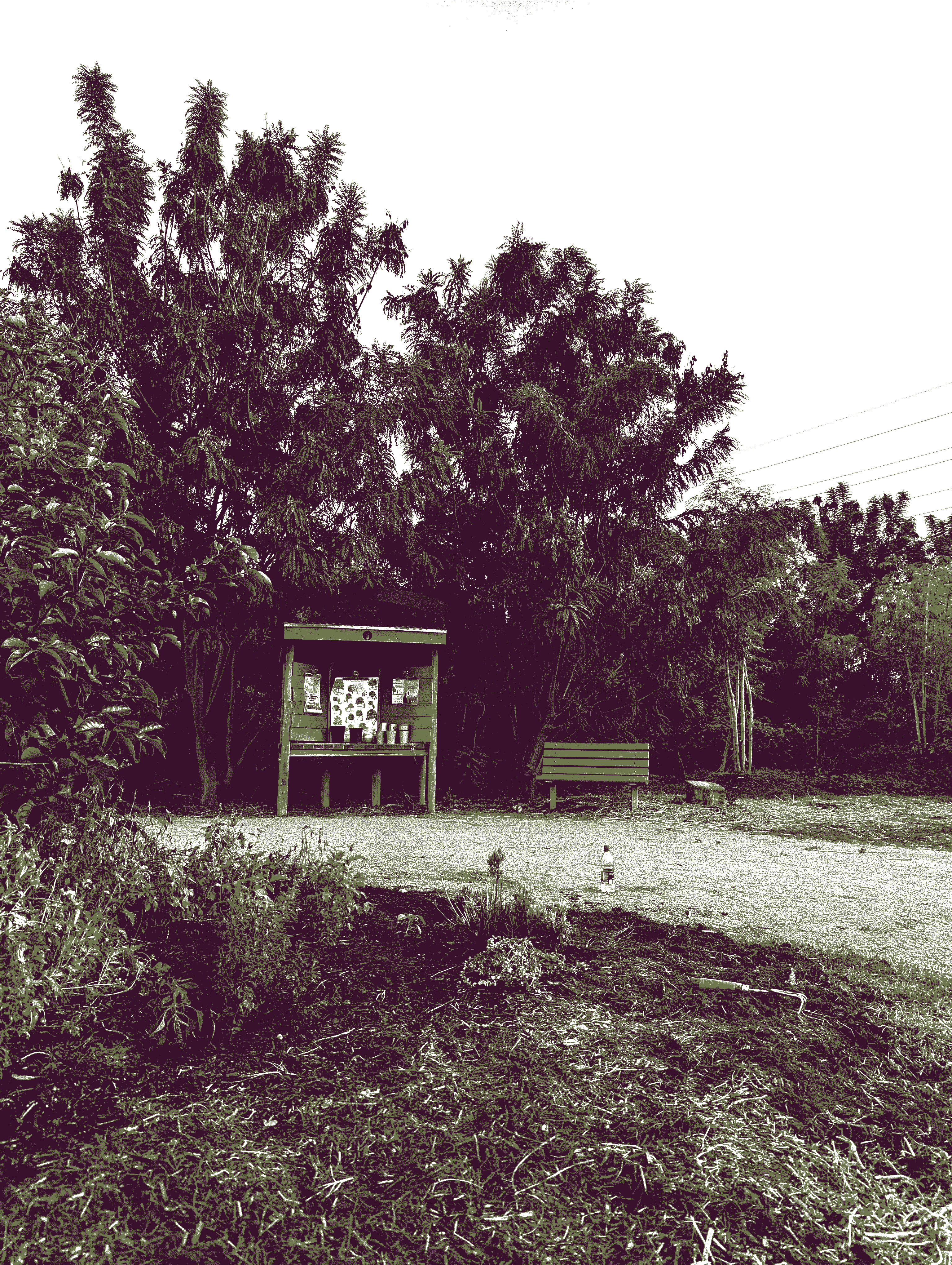
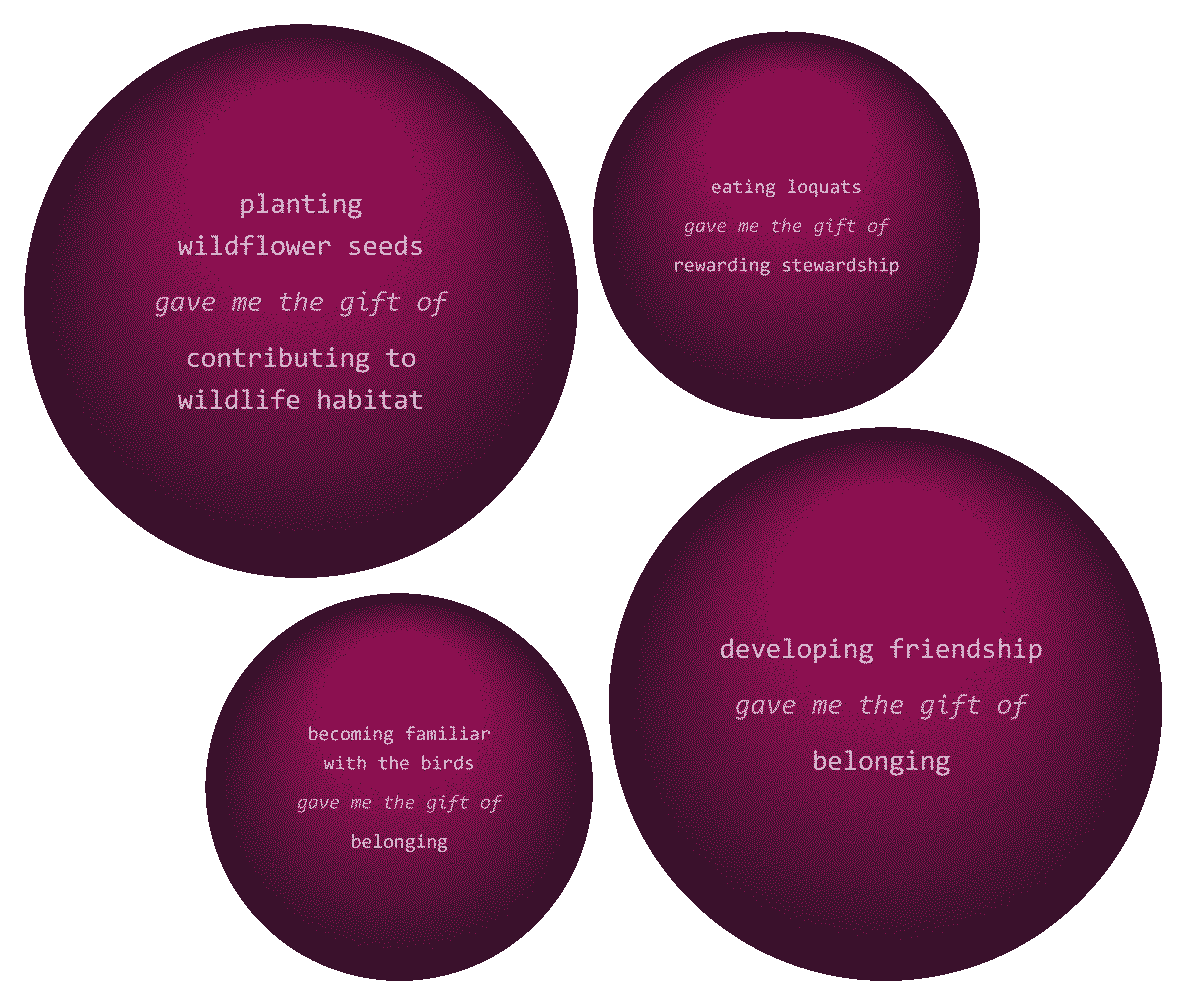
At the food forest, small moments slowly cultivate ecological and social belonging
The food forest catalyzes systemic change
Small moments foment emergent effects that reverberate in Austin and beyond.
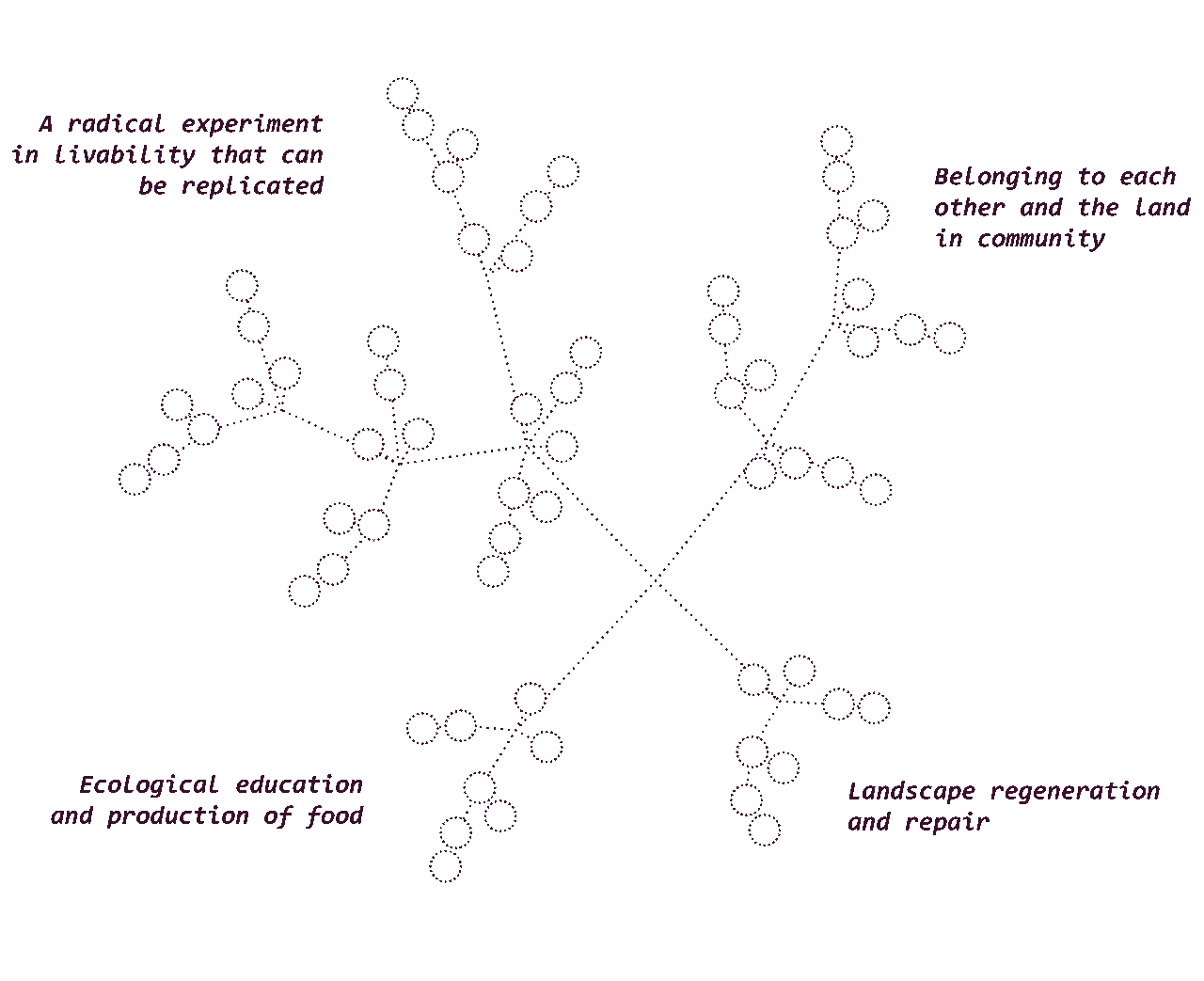
Elinor Ostrom's nobel prize winning work shows that reciprocity and cooperation (among other variables) leads to viable stewardship of land and community (231).
The PROBLEM
The food forest's gifts of livability unfold in quiet, ephemeral, and often fleeting moments
The richness of reciprocity and cooperation lives in those hard to explain moments.
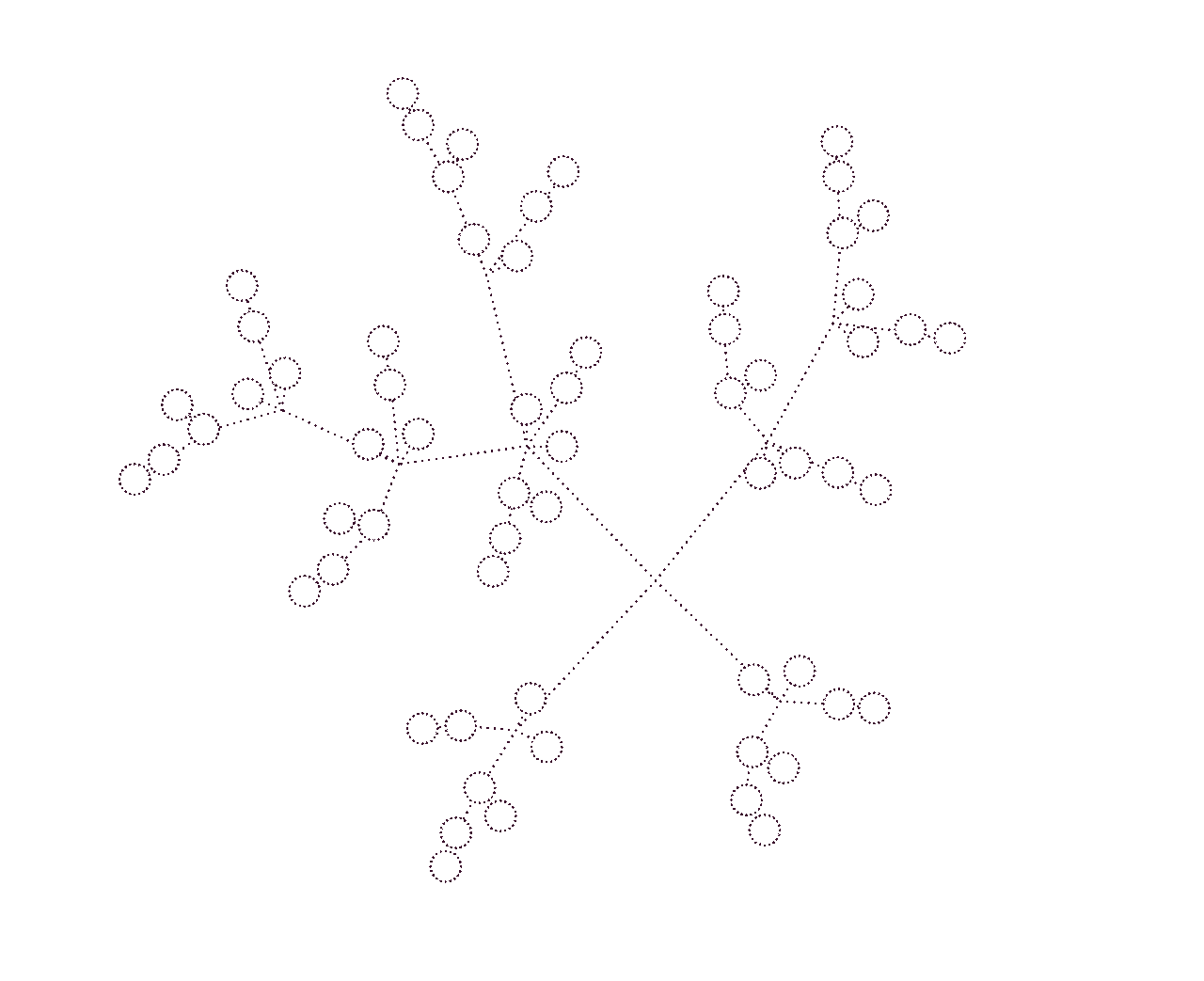
Making gifts tangible helps the food forest community understand and explain the nature of its value to the community.
How can data collection and visualization elevate the gifts of reciprocal relationship, community and stewardship?
Our project collects and visualizes (often ephemeral) gifts received at the food forest
We aim to reveal the unique benefit of the food forest and the reciprocal relationships that benefit ecology and people.
COLLECTING
the STORIES
We developed a survey to
collect data at the food forest
Our participatory design process:
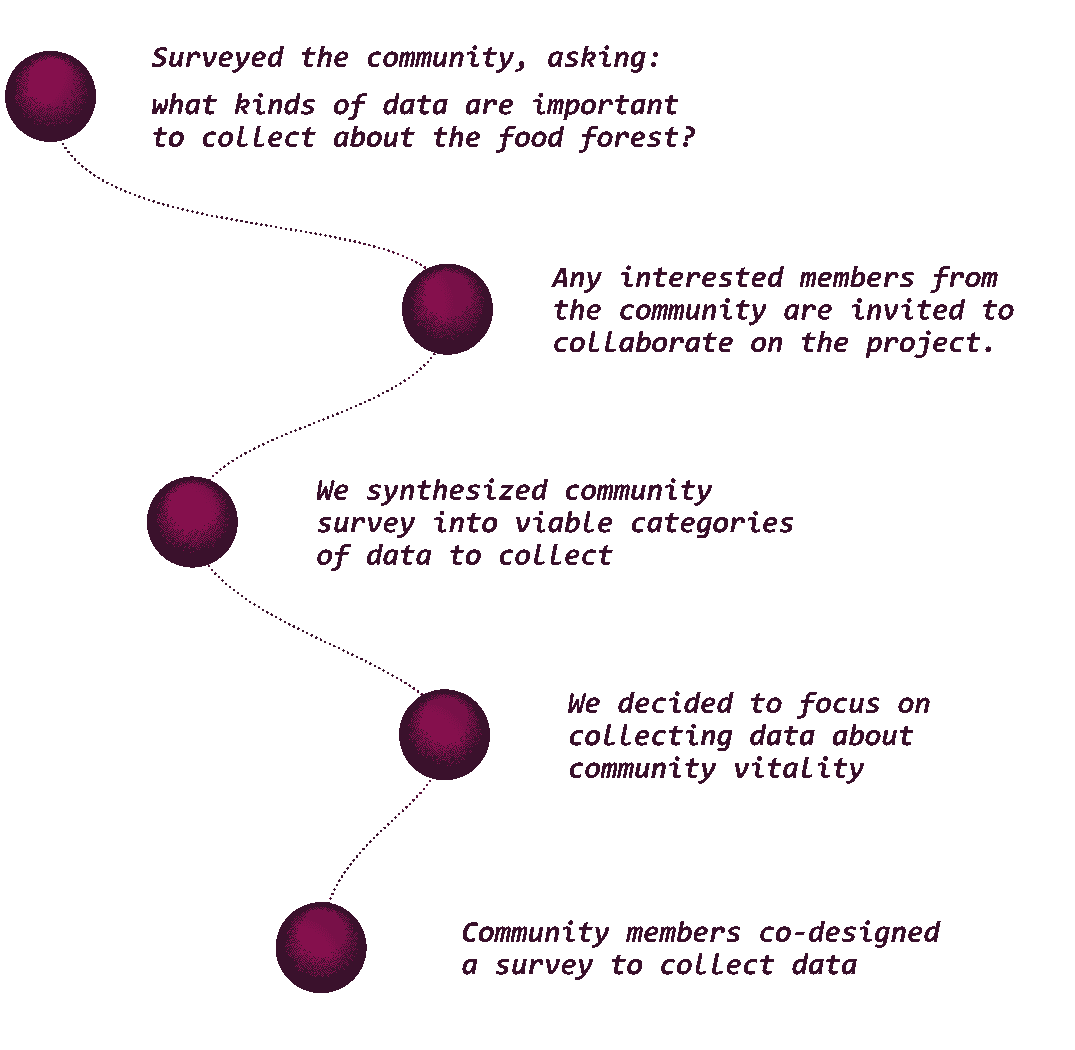
Our community wanted to center human stories and vitality as one key type of data to collect.
Framing our survey around gifts centers gratitude in connection
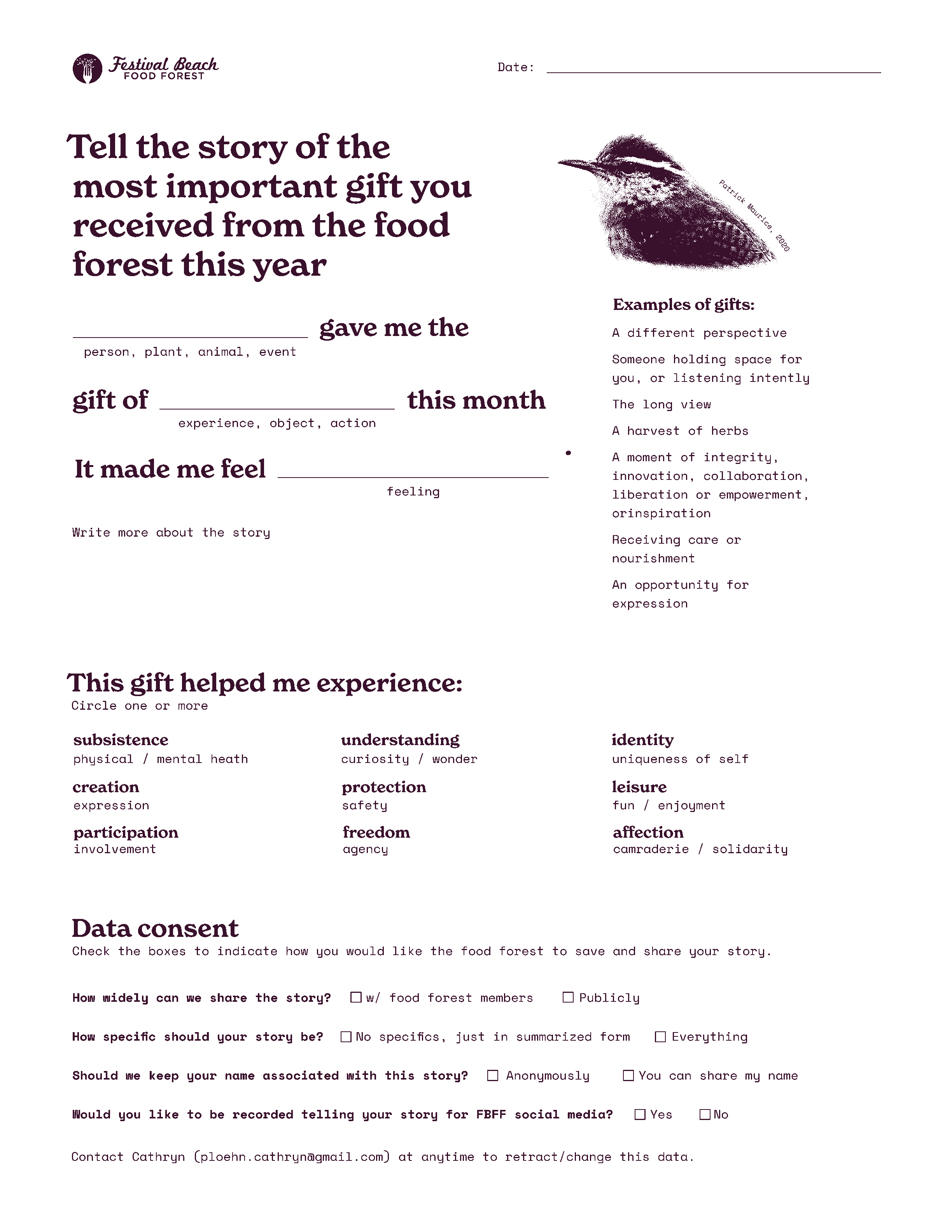
Our survey asks respondents to share their stories of gifts recieved at the food forest.
Collecting data on gifts make the ephemeral acts of care and community tangible.
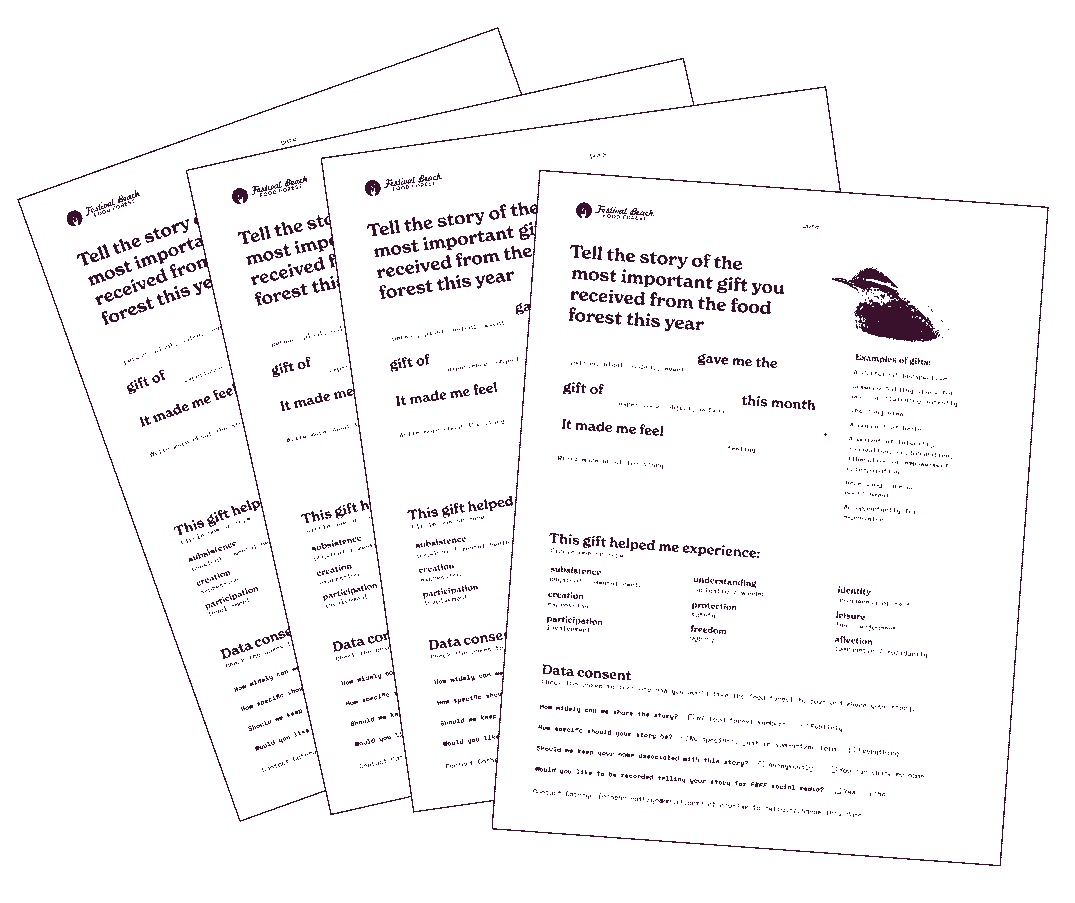
Filling out a survey about the gifts you've recieved becomes a practice of gratitude.
In a world driven to climate catastrophe by detatched consumer-driven extraction, gratitude is a balm.
Emerging research suggests that "gratitude to nature is associated with engagement in pro-environmental behavior." (Tam)
Gratitude puts us in right relationship with the world in satiatng our hunger for wholeness.
The data we collect
The survey starts with the basics of the gift:
| name | data type |
|---|---|
| gift giver | text |
| gift | text |
| feeling | text |
| story description | text (longform) |
We also ask participants to evaluate which (Max-Neef) human needs were met by the gift.
| need | description | data type |
|---|---|---|
| subsistence | physical / mental heath | boolean (TRUE or FALSE) |
| creation | expression | "" |
| participation | involvement | "" |
| understanding | curiosity / wonder | "" |
| protection | safety | "" |
| freedom | agency | "" |
| identity | uniqueness of self | "" |
| leisure | fun / enjoyment | "" |
| affection | camraderie / solidarity | "" |
The participants consent to the level of disclosure they feel comfortable with.
| question | options |
|---|---|
| How widely can we share the story? | With food forest members - or - Publicly |
| How specific should your story be? | No specifics, just in summarized form - or - Everything |
| Would you like to be recorded telling your story to FBFF for social media? | Yes - or - No |
Our corpus of data reveals that a multiplicity of human needs are met in the food forest

Our data collection is ongoing as of summer 2023.
VISUALIZING
the STORIES
Cathryn Ploehn developed the following process for visualizing gifts data using an elderberry simulation.
The work is done as part of their practice, Feral Data Visualization, which reimagines data visualization for the ecological, queer, feminist, and embodied using place-based botanical simulation.
Visualizing gifts as berries embodies gratitude
In the summer of 2023, we began our design process with the hunch to visualize our gifts data as berries.
A plant freely gives its berries in exchange of the spread of seeds.
In The Serviceberry, Kimmerer mentions that the Potawatomi root word for berry is also the root word for gift:
"...these are gifts from our plant relatives, manifestations of their generosity, care, and creativity" (7)
Elderberry as metaphor
Later in the summer of 2023, we chose to try representing the gifts of Festival Beach Food Forest as elderberries, a plant with a healing and nourishing presence in the Blackland Prairies and Edwards Plateau.
_(23663427868).gif)
Like the food forest resides on the edge of what's possible, Elderberries reside on the edges of riparian thickets in Central Texas (Wildflower.org).
Elderberry roots stabilize and protect riverbanks from erosion (Wildflower.org) like the food forest protects the vibrancy of the landscape.
.gif)
© William L. Farr (CC-BY-SA-4.0) modified (source)
Elderberry shrubs provide habitat for pollinators and birds feast on elderberries in August and September (Sambucus nigra ssp. canadensis).
Birds, like Cardinals, enjoy the nourishment of the berries like visitors to the food forest enjoy gifts (Audubon).
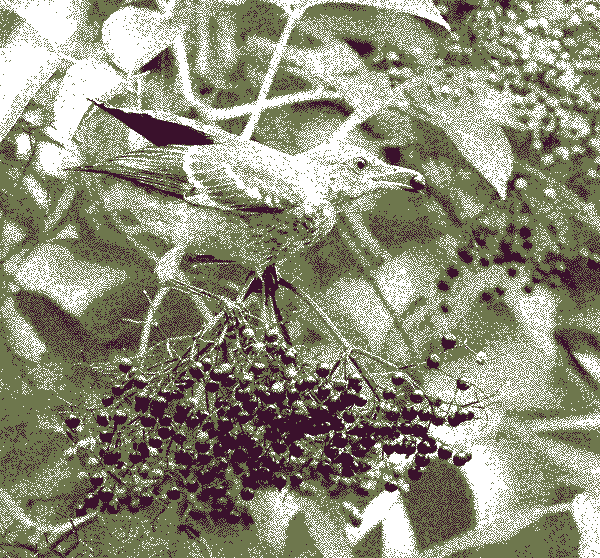
Birds spread the seeds (Wildflower.org) like just as the gifts of the food forest revererate into the community and system.
Of course, Elderberries are primarily known as a medicinal plant.
Elderberries are a key food of indigenous groups in the region, and considered one of the "natural world's best medicines" (Salmón).
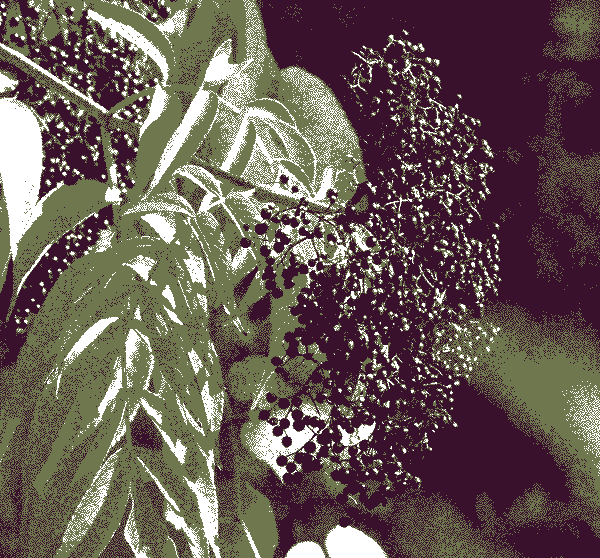
© George Afghan (CC-BY-NC-4.0) modified (source)
Like elderberry syrup staves illness (Salmón), the food forest creates the conditions for healing our connection with our ecologies and one another.
The anti-inflammatory quality of elderberries (Salmón) invokes the existential peace that can be achieved at the food forest.
Studying and simulating Elderberries with code
Ploehn spent 1.5 years studying the visual presence of elderberries at the Food Forest and bringing a simulation to life.
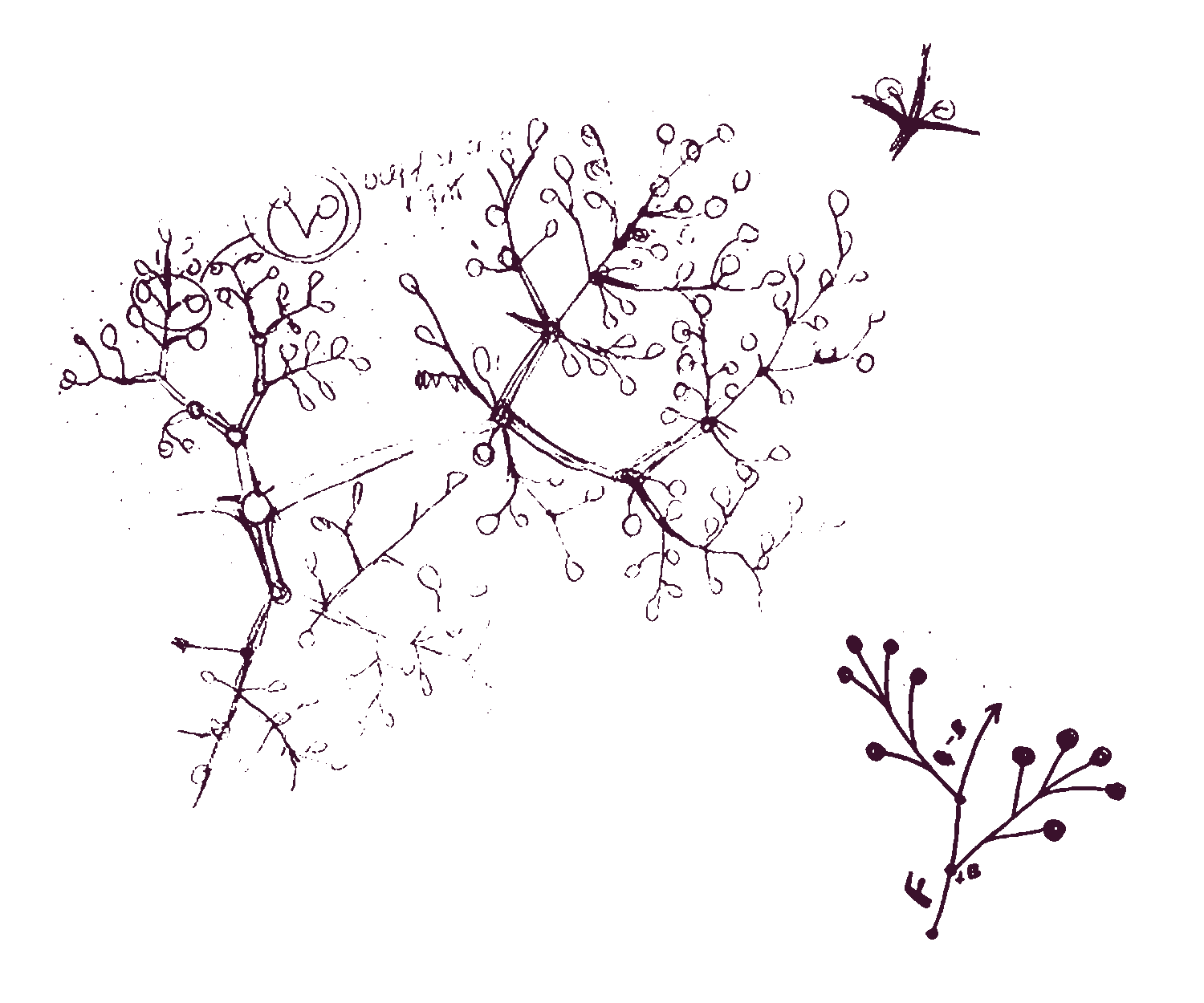
In drawing elderberry clusters, an attunement to the rhythym of the branching pattern emerges.
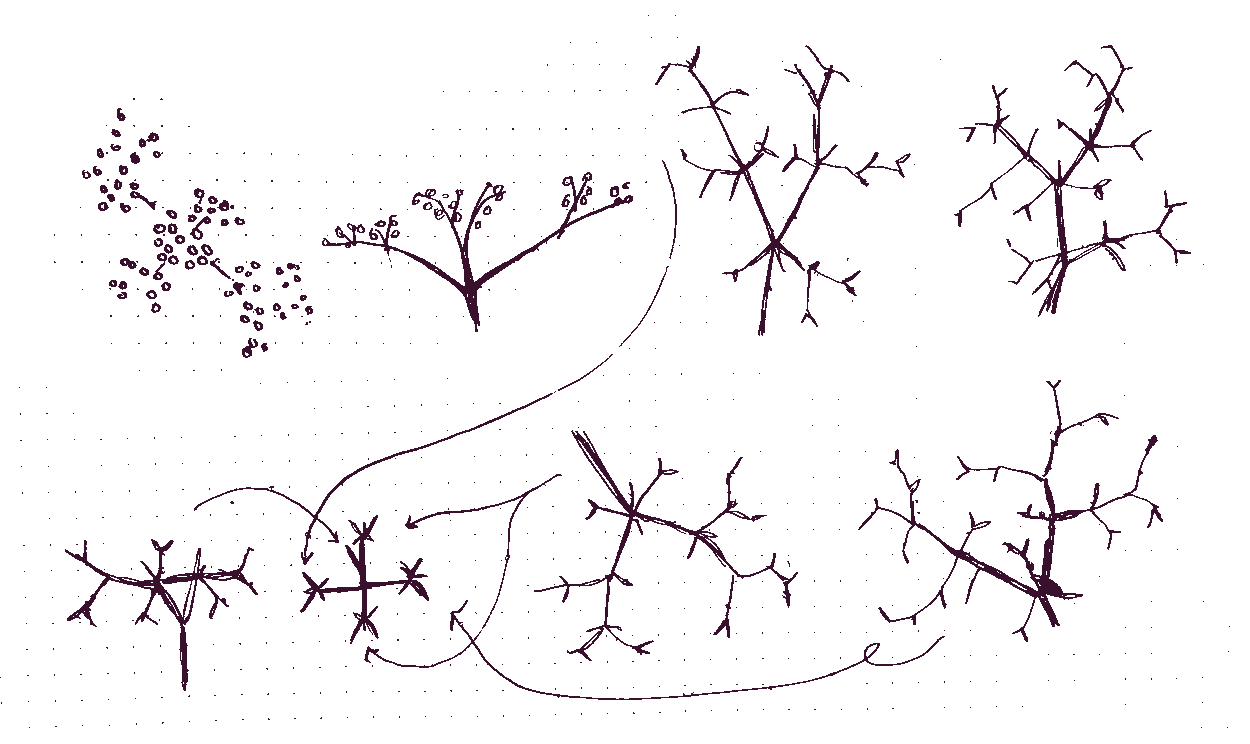
A custom L-system (Lindenmayer system) was developed with JavaScript to approximate the particular branching pattern.
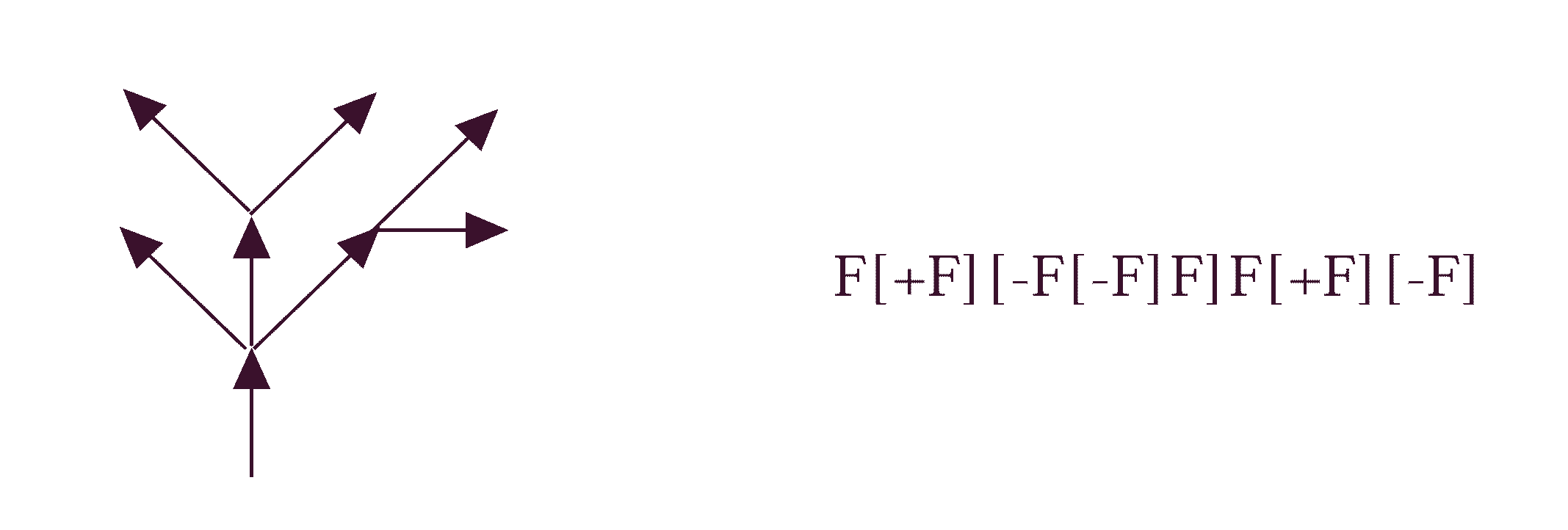
Close attunement to the elderberry cluster cultivates an intimate relationship to the berries.
In sort, the multitudes of an elderberry can never be fully simulated.
Permacomputing techniques constrain the energy demand of the visualization
Permacomputing challenges the envrionmental destructiveness of maximalist computational aesthetics and practices.
[Dithering is used liberally]
Interacting with an elderberry visualization centers ecological gratitude
In exploring our dataset of gifts received at Festival Beach Food Forest, you take on the role of a bird feasting on the gift of berries.
Consuming our gift data as berries also reinforces the notion of thankfulness for the earths's bounty.
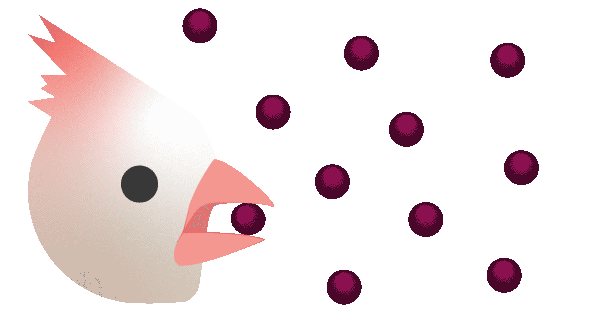
According to Kimmerer in The Serviceberry: when we speak of the earthly sustencances (like berries), as gifts, our relationship with the Earth is pushed towards a responsibility of "respect, reciprocity, and gratitude" (Kimmerer 9).
Exploring each data point embodies the idea that our lives are contingent on the gifts of the Earth
Sources cited
- Grow These Native Plants So Your Backyard Birds Can Feast | Audubon. 10 Feb. 2017, https://www.audubon.org/news/grow-these-native-plants-so-your-backyard-birds-can-feast.
- Kimmerer, Robin Wall. The Serviceberry: Abundance and Reciprocity in the Natural World. 1st ed, Scribner, 2024.
- Poteete, Amy R., et al. Working Together: Collective Action, the Commons, and Multiple Methods in Practice. Princeton University Press, 2010. DOI.org (Crossref), https://doi.org/10.1515/9781400835157.
- Prusinkiewicz, Przemyslaw, and Aristid Lindenmayer. The Algorithmic Beauty of Plants. Springer Science & Business Media, 2012.
- Salmón, Enrique. Iwígara: American Indian Ethnobotanical Traditions and Science. Timber Press, 2020.
- Sambucus Nigra Ssp. Canadensis (Common Elderberry) | Native Plants of North America. https://www.wildflower.org/plants/result.php?id_plant=sanic4. Accessed 22 Feb. 2025.
- Tam, Kim-Pong. “Gratitude to Nature: Presenting a Theory of Its Conceptualization, Measurement, and Effects on pro-Environmental Behavior.” Journal of Environmental Psychology, vol. 79, Feb. 2022, p. 101754. ScienceDirect, https://doi.org/10.1016/j.jenvp.2021.101754.